



Chicken manure is often viewed as a difficult agricultural residue, but with the right processing route, it can become a standardized fertilizer product that is easier to store, transport, handle, and commercialize. The transformation from loose manure into uniform granules is not simply a matter of pressing material through a machine. It involves raw-material preparation, moisture management, mixing, granulation, cooling, screening, and packaging.
For farms, fertilizer producers, and agricultural recycling businesses, the real question is not only whether chicken manure can be pelletized, but whether the final product can be produced consistently enough to meet a practical market requirement.
This is where a complete manure pelletizing process becomes important.
Why Pelletizing Chicken Manure Changes the Value of the Material
Fresh chicken manure contains organic matter and plant nutrients, but its original form is difficult to use commercially. It can be wet, sticky, dusty after drying, irregular in size, and expensive to transport relative to a standardized granular product.
Pelletizing addresses several of these practical problems.
A granular fertilizer is easier to meter during application, easier to bag, and more convenient for wholesalers and agricultural retailers. Uniform particle size can also make the product more suitable for mechanical spreading.
The pelletizing process does not magically create nutrients. Its main purpose is to transform the physical form of the material while supporting a more controlled production process.
For this reason, businesses planning a manure fertilizer project should consider the entire processing chain rather than choosing a granulator first.
The Process Begins Before Granulation
One of the most common mistakes in manure processing projects is treating the pelletizer as the first machine that matters.
In practice, raw-material preparation can determine whether the entire system operates smoothly.
Chicken manure may arrive with varying moisture content, bedding residues, feathers, clumps, and other agricultural impurities. Depending on the source, the material may first require composting, drying, crushing, or screening.
Composting is especially relevant when the project objective includes producing a stabilized organic fertilizer. The biological treatment stage can reduce the problems associated with freshly collected manure and make the material more suitable for downstream processing.
After stabilization, moisture becomes a critical production variable.
Why Moisture Is a Production Variable, Not a Minor Detail
A manure pelletizing system needs material with physical properties suitable for granulation. If the feedstock is excessively wet, it may stick to internal surfaces, form unstable agglomerates, or create difficulties during screening and cooling.
If the material is too dry, the particles may struggle to form and the finished granules can become more fragile.
This is why drying equipment, mixing equipment, and moisture adjustment are often considered together with the pelletizing machine.
A well-designed project may therefore include a dryer after pretreatment, followed by a crusher and mixer before granulation. The exact sequence depends on the raw manure characteristics and the desired product.
The important point is that moisture should be measured and managed, rather than estimated only by visual inspection.
What Happens Inside the Pelletizing Stage?
Once the prepared chicken manure reaches a suitable condition, the material enters the granulation section.
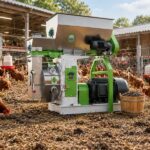
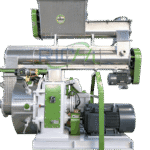
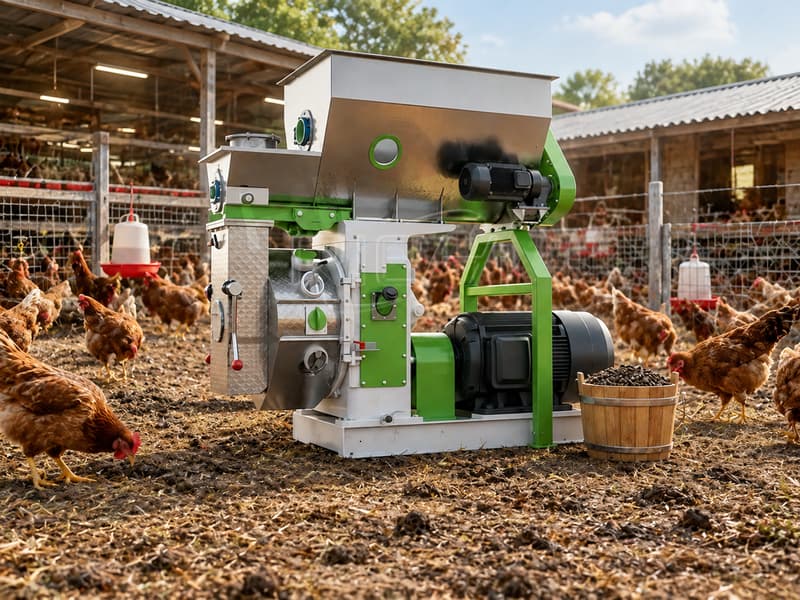
At this stage, a chicken manure pellet machine is used to compress and shape the processed fertilizer feed into regular granules.
The machine is only one part of the process, but it is central to determining the shape and production performance of the finished fertilizer.
The final pellet size depends on the die configuration and the project specification. Different markets may prefer different particle sizes based on spreading equipment, packaging format, and end-user preference.
The granulation stage should therefore be designed around the intended product, not simply around the machine itself.
A Complete System Can Reduce Production Bottlenecks
A professional fertilizer project typically connects multiple processing steps into a continuous or semi-continuous workflow.
A representative process may include:
Raw manure collection → biological treatment → drying → crushing → mixing → granulation → cooling → screening → packaging.
The exact machinery configuration can change according to raw-material conditions.
For example, a farm processing relatively dry manure may not need the same drying capacity as a commercial fertilizer manufacturer handling wetter material. Likewise, a producer making several fertilizer formulations may need a more flexible mixing system.
This is why production capacity should never be selected independently from raw-material characteristics.
Matching Capacity to the Business Model
Small farms and regional fertilizer producers often prefer equipment that matches their actual daily material availability instead of selecting a very large system.
A producer working with several tons of manure per day may evaluate a 2-3T/H Cow Manure Fertilizer Pellet Machine for sale as a reference when comparing equipment and capacity levels for organic fertilizer applications.
However, a machine rated for a specific capacity does not mean every raw material will achieve that exact output. Actual throughput can vary according to moisture, density, particle size, formulation, and operating conditions.
Capacity planning should therefore start with four questions:
How much raw manure is available each day?
How many operating hours are planned?
What moisture range will enter the granulation process?
What finished-product output is required?
These questions are more useful than selecting equipment based only on a headline capacity number.
Can Chicken Manure Pellets Be Customized?
Yes, in many commercial projects, formulation flexibility is more valuable than producing one standard pellet forever.
A fertilizer company may combine chicken manure with other organic materials depending on the target product. Agricultural residues, composted materials, and mineral components may be introduced to adjust the formulation.
The mixer becomes particularly important in this situation because uniform distribution of different materials affects the consistency of the final product.
A project can also be designed around different packaging sizes. Bulk bags may be suitable for agricultural customers, while smaller bags can target retail channels.
Therefore, pelletizing should be considered as part of product development rather than as an isolated mechanical process.
Cooling and Screening Are Often Overlooked
After granulation, freshly formed fertilizer particles may still have elevated temperature or insufficient mechanical stability.
Cooling helps bring the product toward a more manageable condition for handling and packaging.
Screening performs another important role. Not all particles leaving the granulator will have exactly the desired size. Oversize and undersize material can be separated, and suitable material can continue toward packaging.
Depending on the system design, unsuitable fractions may be returned to the production cycle instead of becoming waste.
This approach can improve material utilization and help maintain product consistency.
What Makes the Final Product Commercially Practical?
A marketable fertilizer pellet is not defined by appearance alone.
A commercial buyer may be concerned about particle size consistency, moisture, packaging stability, dust generation, storage behavior, and application convenience.
For producers, the pellet production line also needs to be practical from an operational perspective. Easy access for maintenance, reliable material transfer, suitable dust control, and reasonable energy consumption can affect the overall economics of the project.
A machine that looks suitable in isolation may become less attractive when additional equipment and operating requirements are considered.
Therefore, evaluating the complete process is often more valuable than comparing granulators only by price.
Where Can Farmers Create Additional Value?
One major advantage of manure pellet production is that the same basic processing concept can fit several business models.
A livestock farm may process its own manure to reduce waste-management pressure and create a fertilizer product.
An agricultural service company may collect manure from multiple farms and operate a centralized processing facility.
A fertilizer company may use manure as one component in a broader organic fertilizer portfolio.
A biomass or agricultural residue processor may add manure treatment as an extension of its existing operation.
Each model requires a different approach to raw-material logistics, production scale, and packaging.
Practical Evaluation Before Purchasing Equipment
Before selecting machinery, it is useful to prepare a basic material profile.
Record the approximate moisture content.
Check whether bedding material is mixed with manure.
Measure the amount of material available per day or month.
Define the desired pellet diameter.
Determine whether the product will be sold loose, in bags, or in bulk.
Estimate the operating hours available each day.
These details give an equipment manufacturer a more realistic basis for designing the production process.
Producers can also review helpful resources covering manure treatment, fertilizer processing, drying, and pellet production to understand how each stage affects the final system.
Final Thoughts
Turning chicken manure into fertilizer pellets is a process-engineering project rather than a single-machine purchase. The best results usually come from matching pretreatment, moisture control, granulation, cooling, screening, and packaging to the actual raw material and market objective.
For new fertilizer businesses, the transformation is particularly interesting because it converts an inconsistent agricultural residue into a more standardized commercial product.
The opportunity is therefore not just to make pellets. It is to build a stable production system in which waste collection, processing, product quality, and market demand work together.


