


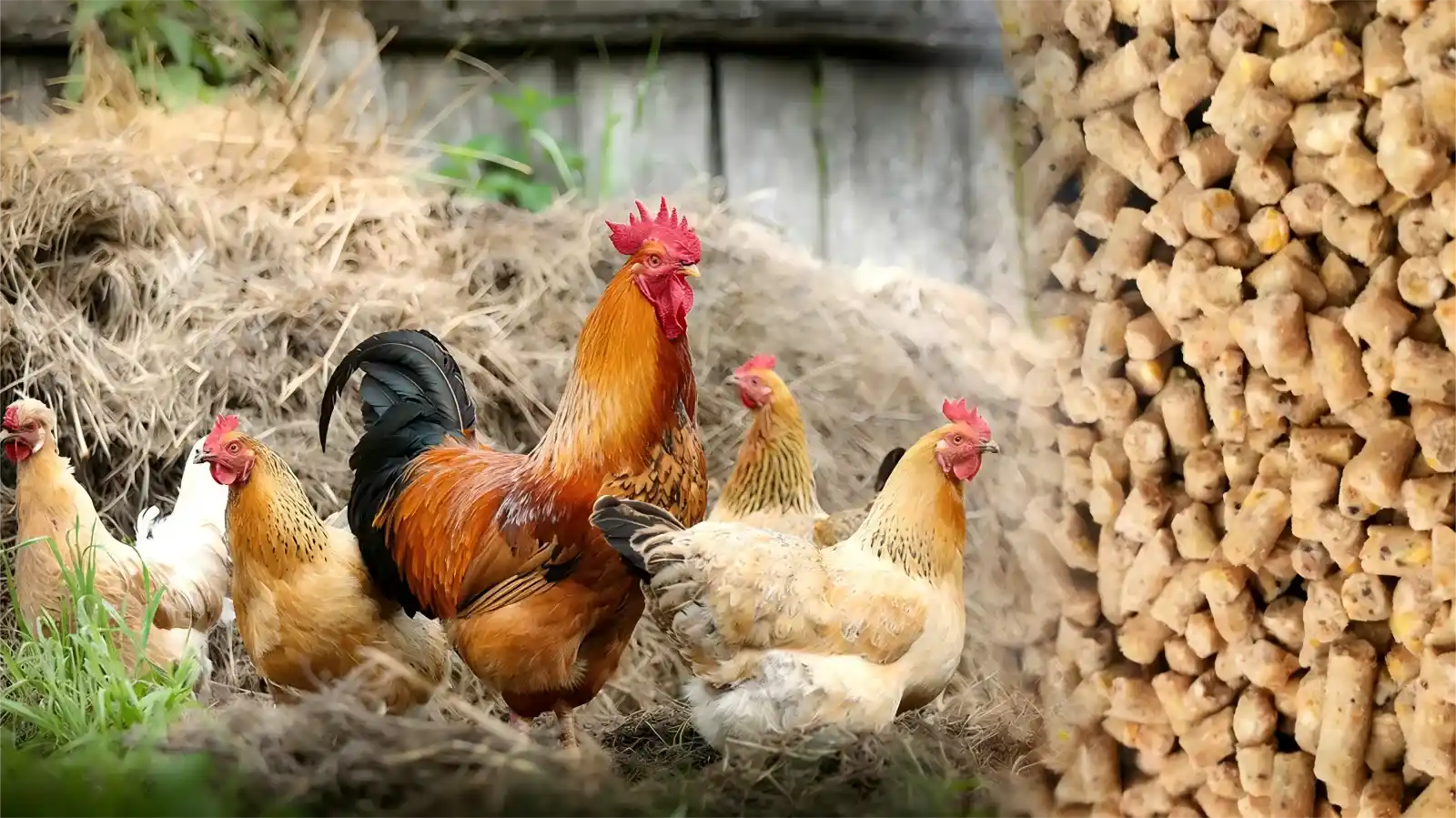
Modern chicken feed pellet production technology is an integrated manufacturing process used to convert grains, protein meals, forage materials, additives, and other suitable ingredients into nutritionally balanced and physically stable poultry feed pellets.
Unlike traditional feed processing, modern pellet production does not rely on a single machine. It combines raw material cleaning, grinding, batching, mixing, conditioning, pelletizing, cooling, screening, crumbling when necessary, conveying, and packaging into a coordinated production system.
The purpose of modern chicken feed pellet technology is not simply to make feed into pellets. It is to achieve consistent nutritional composition, suitable pellet size, good pellet durability, controlled moisture, efficient production, and reliable storage and transportation.
At the center of this process is the pellet mill. When businesses search for a chicken feed pellet machine for sale, they should therefore evaluate not only the machine itself but also how it fits into the complete feed production process.
A properly designed production line can support broiler feed, layer feed, breeder feed, chick starter feed, and other poultry feed products. The equipment configuration can be adjusted according to raw materials, feed formulas, production capacity, pellet diameter, and automation requirements.
1. What Is Chicken Feed Pellet Production Technology?
Chicken feed pellet production technology refers to a series of mechanical and process operations that transform prepared feed ingredients into compact pellets.
A typical production process includes:
Raw Material Receiving → Cleaning → Crushing and Grinding → Batching → Mixing → Conditioning → Pelletizing → Cooling → Screening → Crumbling if Required → Packaging
Not every plant uses exactly the same configuration.
For example, a small poultry farm may use a simple grinding, mixing, and pelletizing system, while a commercial feed mill may use automatic batching, steam conditioning, multiple pellet mills, cooling, screening, packaging, and centralized control.
Modern technology is therefore scalable.
It can be designed for different production capacities and different types of poultry feed.
2. Why Chicken Feed Is Pelletized
Chicken feed can be produced in mash, crumble, or pellet form.
Pelletizing provides several physical advantages.
Pellets are generally:
- Easier to handle
- More uniform in size
- More compact
- Easier to transport
- Suitable for automated feeding
- Less prone to ingredient separation
- Easier to package and store
Pelletizing also provides an opportunity to improve the physical consistency of feed.
However, pelletizing alone does not guarantee good feed quality. The raw material formula, grinding, mixing, conditioning, die selection, cooling, and screening processes must all be properly controlled.
3. Raw Materials Used in Modern Chicken Feed Production
Modern chicken feed plants can process many types of ingredients.
Common raw materials include:
- Corn
- Wheat
- Barley
- Sorghum
- Soybean meal
- Wheat bran
- Rice bran
- Vegetable oil
- Fish meal
- Mineral sources
- Vitamin premixes
- Amino acids
- Other approved feed ingredients
Different chicken categories require different formulas.
Broiler starter feed, broiler finisher feed, layer feed, and breeder feed can have different nutritional requirements.
The production line should therefore be flexible enough to handle formula changes.
4. Raw Material Cleaning
Cleaning is the first major processing stage.
Raw materials can contain unwanted materials such as:
- Stones
- Soil
- Metal
- Plastic
- Fibers
- Oversized particles
Cleaning equipment may include vibrating screens, pre-cleaners, magnetic separators, and other separation systems.
Removing contaminants protects downstream equipment and helps maintain feed quality.
A metal particle, for example, can damage a hammer mill or pellet mill if it enters the processing system.
Modern feed plants therefore place considerable emphasis on raw material cleaning.
5. Crushing and Grinding Technology
Grinding reduces the particle size of grains and other suitable ingredients.
Hammer mills are commonly used in poultry feed production.
Grinding affects:
- Mixing uniformity
- Pellet formation
- Pellet quality
- Feed texture
- Energy consumption
The ideal particle size depends on the feed formula and target poultry.
If particles are too large, they may not mix evenly.
If particles are excessively fine, energy consumption may increase and dust levels may become higher.
Modern grinding technology focuses on achieving the required particle size efficiently rather than simply grinding as finely as possible.
6. Automatic Batching Technology
After grinding, ingredients need to be measured according to the feed formula.
Modern feed plants use automatic batching systems to control ingredient quantities.
A batching system may include:
- Storage bins
- Feeders
- Weighing hoppers
- Load cells
- Discharge gates
- Control software
The system can automatically weigh ingredients according to the programmed recipe.
This improves formula accuracy and reduces manual weighing errors.
Automatic batching is especially important when the feed formula contains small amounts of vitamins, minerals, amino acids, or other additives.
7. Modern Mixing Technology
After batching, the ingredients are transferred to a mixer.
The purpose of mixing is to distribute all ingredients as uniformly as possible.
Common mixer designs include:
- Horizontal mixers
- Paddle mixers
- Ribbon mixers
- Twin-shaft mixers
A good mixer should achieve uniformity without excessive mixing time.
Poor mixing can create nutritional variation within the same batch.
Modern mixers can also be integrated with liquid addition systems when the formula contains oil, fat, molasses, or other liquid ingredients.
8. Liquid Ingredient Addition
Liquid ingredients may be used to improve nutritional density or physical characteristics.
For example, vegetable oil or other liquid components may be included in certain poultry formulas.
A modern liquid addition system can include:
- Storage tanks
- Pumps
- Flow meters
- Spray nozzles
- Automatic valves
The purpose is to distribute liquid ingredients evenly throughout the feed mixture.
Controlled liquid addition also helps maintain more consistent moisture and pelletizing conditions.
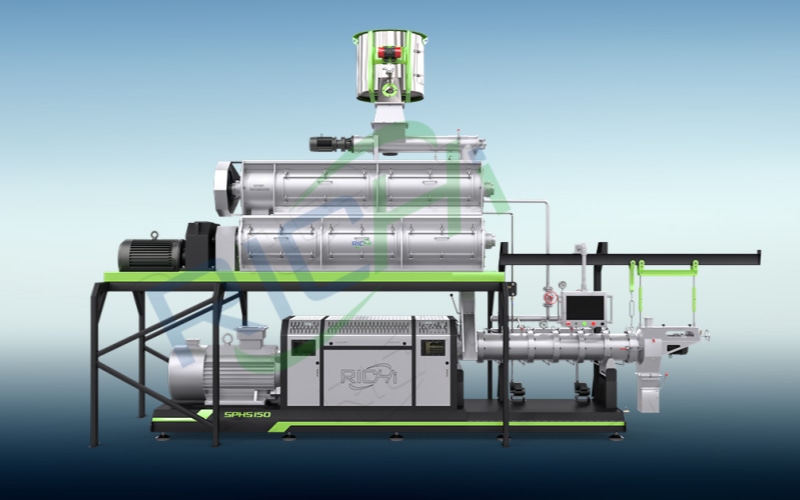
9. Steam Conditioning
Steam conditioning is one of the important technologies used in modern pellet production.
Before the material enters the pellet mill, steam can be added under controlled conditions.
This increases the temperature and moisture of the feed mixture.
Proper conditioning can help:
- Improve material flow
- Improve pellet formation
- Increase pellet durability
- Stabilize pelletizing
- Reduce excessive fines
- Improve production efficiency
The exact conditioning parameters depend on the formula.
A high-starch feed may respond differently from a formula containing higher levels of protein or fiber.
Therefore, steam should be controlled according to actual process requirements.
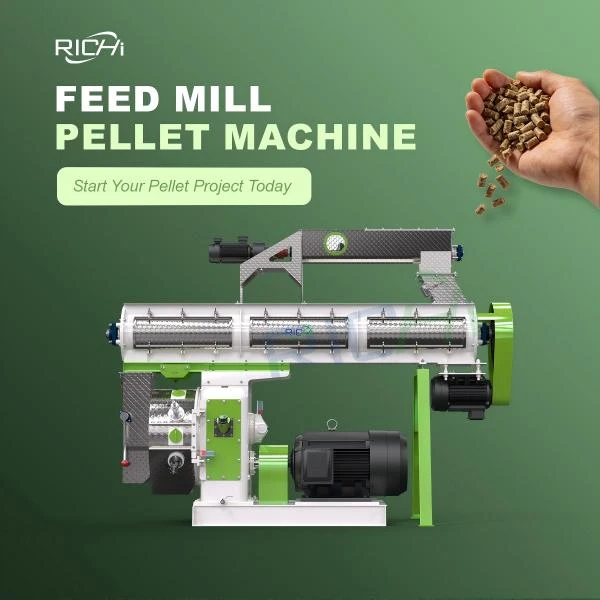
10. The Chicken Feed Pellet Mill
The pellet mill is the core equipment in the pelletizing stage.
The prepared and conditioned feed mixture enters the pellet mill and is compressed between rollers and a die.
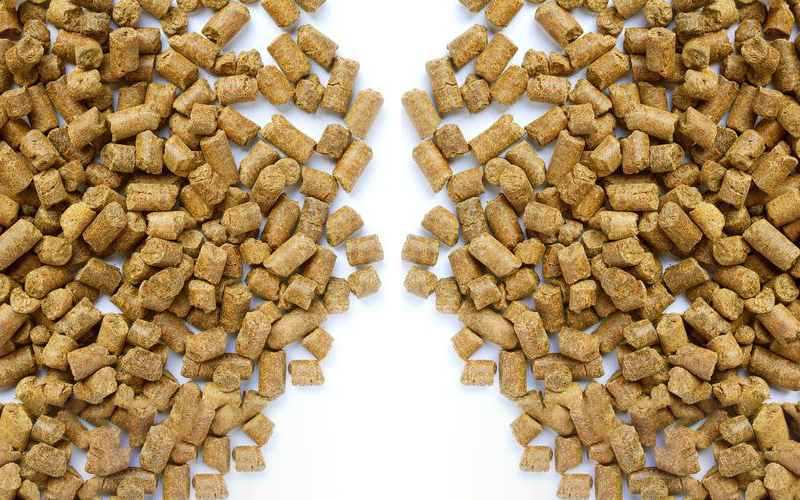
The material passes through holes in the die and forms continuous strands of compressed feed.
A cutting system then produces pellets of the required length.
The pellet mill influences:
- Pellet diameter
- Pellet density
- Pellet durability
- Production capacity
- Energy consumption
When customers search for a chicken feed pellet machine for sale, these factors should be considered together rather than looking only at the machine’s purchase price.
(Learn more:https://richipelletizer.com/chicken-feed-pellet-machine-for-sale)
11. How the Die Determines Pellet Size
The die contains holes that determine the basic pellet diameter.
Different poultry feed products may require different pellet sizes.
For example, young chicks generally need smaller feed particles than mature broilers.
A feed plant may use different dies to produce:
- Starter feed
- Grower feed
- Finisher feed
- Layer feed
- Breeder feed
The appropriate die should be selected according to the target poultry, formula, production capacity, and desired pellet specifications.
12. Compression Ratio and Pellet Quality
The die compression ratio influences how strongly the feed material is compressed.
Different formulas can require different compression characteristics.
Factors that influence die selection include:
- Raw material composition
- Starch content
- Protein content
- Fiber level
- Moisture
- Pellet diameter
- Required durability
An unsuitable compression ratio can cause problems such as poor pellet formation, excessive fines, unstable output, or higher energy consumption.
Therefore, die selection should be treated as part of the overall process design.
13. Pellet Durability
Pellet durability is an important physical quality indicator.
Feed pellets must withstand:
- Cooling
- Screening
- Conveying
- Packaging
- Transportation
- Storage
If pellets break too easily, excessive fines can be produced.
The main factors affecting durability include:
- Particle size
- Formula
- Moisture
- Conditioning
- Die compression
- Roller condition
- Cooling
Modern pellet production technology aims to create pellets that are strong enough for handling without becoming unnecessarily dense.
14. Cooling Technology
Fresh pellets leave the pellet mill at elevated temperature.
They need to be cooled before storage and packaging.
A counterflow cooler or other suitable cooling system uses controlled airflow to reduce pellet temperature and moisture.
Proper cooling helps prevent:
- Condensation
- Mold
- Storage deterioration
- Pellet deformation
- Excessive breakage
The cooler must be matched to the capacity of the pellet mill.
If the cooling system is too small, it can become a bottleneck in the production line.
15. Screening Technology
After cooling, pellets are screened to separate finished products from fines and broken particles.
A vibrating screen is commonly used.
The screening process helps produce a more consistent finished product.
Depending on the plant design, suitable fines can be returned to the production process.
This improves material utilization and reduces unnecessary waste.
Screening also helps ensure that the feed delivered to packaging equipment has a more uniform physical specification.
16. Crumbling Technology for Chick Feed
Young chicks may require smaller feed particles than older poultry.
Instead of producing extremely small pellets directly, a feed plant can pelletize the material and then use a crumbler.
The process becomes:
Pelletizing → Cooling → Crumbling → Screening
The crumbler breaks larger pellets into smaller particles.
This can provide a practical way to manufacture starter feed while maintaining the advantages of pellet production.
The final crumb size can be controlled through equipment settings and screening.
17. Modern Technology for Broiler Feed
Broiler feed production often involves several stages.
A commercial broiler program may include:
- Starter feed
- Grower feed
- Finisher feed
Each stage may use a different formula and physical feed specification.
Modern production systems can store multiple recipes in the control system.
The operator can select the required formula and production parameters.
The same production line can therefore manufacture several types of broiler feed.
18. Modern Technology for Layer Feed
Layer feed has different nutritional requirements from broiler feed.
Calcium and mineral management are particularly important for laying hens because of eggshell formation.
A modern layer feed production line needs accurate batching and uniform mixing to ensure that minerals and other micro-ingredients are properly distributed.
Pelletizing can then convert the prepared mixture into a more compact and consistent feed form.
The appropriate pellet diameter and physical characteristics depend on the feeding program.
19. Modern Technology for Breeder Feed
Breeder chickens may require controlled levels of energy, protein, minerals, and other nutrients.
Feed production technology helps maintain formula consistency.
Automatic batching and mixing systems are particularly useful when formulas contain multiple ingredients at different inclusion levels.
A reliable production process can reduce variation between batches.
20. Automation in Modern Chicken Feed Pellet Production
Automation is one of the defining characteristics of modern feed production.
A centralized control system can coordinate:
- Raw material feeding
- Grinding
- Batching
- Mixing
- Conditioning
- Pelletizing
- Cooling
- Screening
- Packaging
Automation can reduce repetitive manual work and improve process consistency.
For large feed plants, automatic recipe management also allows operators to produce different formulas with greater control.
21. Sensors and Process Monitoring
Modern production lines can use sensors to monitor important operating parameters.
These may include:
- Temperature
- Moisture
- Material level
- Motor load
- Weight
- Pressure
- Equipment status
Monitoring helps operators identify abnormal conditions.
For example, a sudden increase in pellet mill motor load may indicate a feeding problem, unsuitable moisture, or a mechanical issue.
Process monitoring therefore supports both quality control and equipment maintenance.
22. Energy-Efficient Feed Production
Energy consumption is an important part of feed manufacturing costs.
Modern equipment can improve energy efficiency through:
- Efficient motors
- Variable-frequency drives
- Optimized grinding
- Stable pellet mill operation
- Efficient cooling
- Proper material conveying
Correct equipment sizing is also important.
An undersized machine may operate under excessive load, while oversized equipment can increase investment and energy costs without providing additional value.
23. Dust Collection Technology
Grinding and handling feed ingredients can generate dust.
A modern chicken feed plant may use a dust collection system consisting of:
- Dust hoods
- Ductwork
- Fans
- Cyclones
- Bag filters
Dust collection helps maintain a cleaner production environment and protects equipment.
It also helps reduce material losses caused by uncontrolled airborne particles.
24. Conveying and Storage Equipment
Material conveying equipment connects different processing stages.
Common systems include:
- Screw conveyors
- Belt conveyors
- Bucket elevators
- Drag conveyors
Storage equipment can include:
- Ingredient bins
- Steel silos
- Finished feed bins
- Additive storage bins
Efficient material handling reduces unnecessary transfers and supports continuous production.
The plant layout should be designed so that raw materials move through the process in a logical direction.
25. Automatic Packaging
After screening, finished chicken feed can be sent to an automatic packing system.
A modern packing machine may include:
- Automatic weighing
- Bag filling
- Bag clamping
- Sealing or sewing
- Bag conveying
Automatic packaging improves weighing consistency and reduces repetitive manual labor.
For commercial feed manufacturers, it can also improve product handling and warehouse management.
26. Quality Control in Modern Chicken Feed Production
Modern pellet production technology requires quality control at multiple stages.
Important parameters include:
Raw Material Quality
Ingredients should meet appropriate quality specifications.
Particle Size
Ground materials should have a suitable and consistent particle size.
Mixing Uniformity
Ingredients should be evenly distributed.
Moisture
Moisture should be controlled during conditioning and cooling.
Pellet Diameter
Pellets should match the intended specification.
Pellet Durability
Pellets should withstand normal handling.
Fines
Excessive fines should be minimized.
Storage Stability
Finished feed should remain stable during storage.
Monitoring these factors helps maintain consistent feed quality.
27. What to Look for When Buying a Chicken Feed Pellet Machine for Sale
When evaluating a chicken feed pellet machine for sale, buyers should look beyond the advertised capacity.
Important questions include:
- What feed formulas can the machine process?
- What pellet diameters are available?
- What is the appropriate die compression ratio?
- What raw material moisture is recommended?
- What is the actual production capacity for the intended formula?
- How is the machine lubricated?
- What wear parts need regular replacement?
- What motor and drive system are used?
- How easy is maintenance?
- Can the machine be integrated into an automated production line?
- Is technical support available?
- Can the supplier provide a complete process design?
A machine should be selected according to actual production conditions rather than based solely on catalog specifications.
28. Individual Machine or Complete Production Line?
Some customers only need a pellet mill, while others need a complete feed production line.
A small farm may already have grinding and mixing equipment and only need a pellet machine.
A commercial feed manufacturer may need a complete system including:
Cleaning → Grinding → Batching → Mixing → Conditioning → Pelletizing → Cooling → Screening → Packaging
A complete line can provide better equipment coordination because each machine is designed according to the capacity and requirements of the entire process.
29. Matching Equipment Capacity
Production capacity should be balanced throughout the line.
For example, if the pellet mill can produce 10 tons per hour but the cooler can only handle 6 tons per hour, the actual production capacity will be restricted by the cooling stage.
Similarly, an undersized grinder or mixer can prevent the pellet mill from operating continuously.
Modern production line design therefore considers:
- Grinder capacity
- Mixer capacity
- Conditioner capacity
- Pellet mill capacity
- Cooler capacity
- Screen capacity
- Packing capacity
Balanced equipment improves overall production stability.
30. Maintenance of Modern Pellet Production Equipment
Regular maintenance helps protect production quality.
For the pellet mill, maintenance may include:
- Die inspection
- Roller inspection
- Bearing lubrication
- Gearbox inspection
- Drive system inspection
- Safety system inspection
- Cleaning
- Replacement of worn components
Other machines also require preventive maintenance.
Hammer mill screens and hammers, mixer components, conveyor bearings, cooler fans, and packing equipment should be inspected according to operating conditions.
Preventive maintenance can reduce unexpected downtime and help maintain stable production.
31. Customized Chicken Feed Pellet Production Technology
Not every feed plant has the same requirements.
Customization may be necessary when the customer has:
- Special raw materials
- Multiple formulas
- Different pellet sizes
- High production capacity
- Limited factory space
- Specific automation requirements
- Different packaging specifications
A customized production line can adjust equipment selection and layout according to these conditions.
The process can also be designed for future expansion.
32. RICHI Chicken Feed Pellet Production Solutions
RICHI Pelletizer can design chicken feed production systems according to raw materials, feed formulas, production capacity, pellet size, factory conditions, and automation requirements.
A complete poultry feed line may include:
Raw Material Cleaning → Crushing → Grinding → Batching → Mixing → Conditioning → Chicken Feed Pellet Machine → Cooling → Screening → Crumbling → Packaging
Not every project requires every machine.
The equipment configuration can be customized according to the customer’s actual production process.
For customers searching for a chicken feed pellet machine for sale, the machine can also be supplied as part of a complete production solution when additional equipment is required.
33. Advantages of Modern Chicken Feed Pellet Technology
Modern technology can provide several practical benefits.
Consistent Feed Quality
Controlled processing helps maintain more uniform feed characteristics.
Better Ingredient Distribution
Accurate batching and mixing reduce nutritional variation.
Improved Pellet Durability
Proper conditioning and compression can produce stronger pellets.
Reduced Ingredient Separation
Pelletizing binds ingredients into a more unified physical form.
Easier Handling
Pellets are convenient for conveying, packaging, storage, and transportation.
Flexible Production
The same production line can produce different formulas and pellet sizes.
Higher Automation
Automated systems reduce repetitive manual operations.
Better Production Control
Sensors and centralized controls provide more information about the production process.
Conclusion
Modern chicken feed pellet production technology is an integrated process that combines raw material preparation, grinding, accurate batching, mixing, conditioning, pelletizing, cooling, screening, crumbling, conveying, and packaging.
The chicken feed pellet machine for sale is an important part of this process, but its performance depends on the equipment and process stages surrounding it. A properly selected pellet mill must be matched with the feed formula, raw materials, pellet diameter, production capacity, moisture conditions, and required automation level.
Modern technology can support different poultry feed products, including broiler starter, grower and finisher feed, layer feed, breeder feed, and chick feed. Through accurate formulation, controlled conditioning, appropriate die selection, effective cooling, and proper screening, manufacturers can achieve more consistent physical feed quality.
Automation and digital monitoring further improve production management, while balanced equipment capacities help prevent bottlenecks. For commercial feed manufacturers, a complete production-line approach is often more important than selecting an individual machine.
When investing in chicken feed pellet production equipment, buyers should therefore evaluate the entire process rather than focusing only on the advertised machine price or capacity. The right system should be designed around actual raw materials, formulas, production targets, pellet specifications, factory conditions, and future expansion plans.
With a properly engineered production line, modern chicken feed pellet technology can provide a reliable and flexible way to manufacture consistent poultry feed while improving production efficiency and process control.