

Cat litter looks like a simple product. It is sold in bags, used for a few weeks, and thrown away. Behind that simple product, however, is a manufacturing process with its own raw material challenges, quality requirements, and equipment demands. Many people assume that cat litter production is similar to feed pelleting, because both use pellet mills and both produce granular products. That assumption leads to expensive mistakes.
The two industries share some equipment categories, but they operate under very different rules. Feed is judged by nutritional value and digestibility. Cat litter is judged by absorption speed, odor control, dust level, clumping behavior, and how it feels to a cat’s paws. A production line that works well for animal feed may produce litter that crumbles too easily, generates too much dust, or fails to control odor. Understanding these differences is the first step toward building a cat litter plant that actually works.
The Raw Materials Decide Everything
Cat litter is made from a wide range of materials. The most common include bentonite clay, zeolite, diatomite, sepiolite, attapulgite, and various plant-based fibers such as corn cob, wheat bran, peanut shell, and sawdust. Some products combine mineral and plant materials to balance absorption, clumping, and cost.
Bentonite is the dominant material in clumping litter. It swells when wet and forms a firm clump that is easy to scoop. Its performance depends on the type of bentonite, the sodium content, particle size, and moisture. Not all bentonite is suitable for cat litter. A deposit that works well for drilling mud may produce litter that clumps poorly or generates excessive dust.
Zeolite and diatomite are often used for odor control. Their porous structure traps ammonia and other odorous compounds. Sepiolite and attapulgite offer high absorption capacity and are sometimes blended with bentonite to improve performance. Plant-based materials are cheaper but usually absorb less and may break down faster. They are often used in biodegradable or eco-friendly products.
The raw material strategy should start with the target market. A premium clumping product requires high-quality sodium bentonite and tight process control. A budget product may use blends and fillers to reduce cost. A biodegradable product may use corn cob or wheat fiber, but it must still meet basic performance expectations. The formula and the equipment must match the product positioning.
Why Cat Litter Is Not Feed
Feed pelleting and cat litter granulation look similar on the factory floor, but the objectives are different. Feed pellets must be digestible and nutritionally consistent. Litter granules must be hard enough to resist crushing during packaging and transport, porous enough to absorb liquid quickly, and heavy enough to stay in the litter box without flying around.
Moisture control is critical in both industries, but for different reasons. In feed, moisture affects mold and shelf life. In litter, moisture affects granule strength, dust, and clumping performance. A litter granule that is too dry may be brittle and dusty. One that is too wet may clog the die or form weak granules that break apart in the bag.
Heat also plays a different role. Feed conditioning uses steam to gelatinize starch and bind particles. Cat litter granulation often uses water or steam to activate the binding properties of clay or other materials. The temperature and moisture window is narrower in litter production because overheating can damage the absorption structure of the material.
Dust is a major concern in litter production. Feed dust is undesirable but manageable. Litter dust is a customer complaint. It coats surfaces, irritates eyes and respiratory tracts, and makes the product feel cheap. A litter line must control dust at every stage, from grinding to granulation to packaging.
What a Full Production Line Includes
A cat litter production line is more than a pellet mill. It includes raw material handling, crushing, mixing, granulation, drying, cooling, screening, dust collection, and packaging. Each stage affects the final product.
Crushing reduces raw materials to a consistent particle size. If the grind is too coarse, the granules may be weak. If it is too fine, the material may not flow well through the granulator. The right particle size depends on the raw material and the target granule diameter.
Mixing blends different materials to achieve the desired absorption, clumping, and odor control. Uniformity matters. If the zeolite is not evenly distributed, some granules will control odor better than others. If the binder is uneven, some granules will be strong and others will crumble.
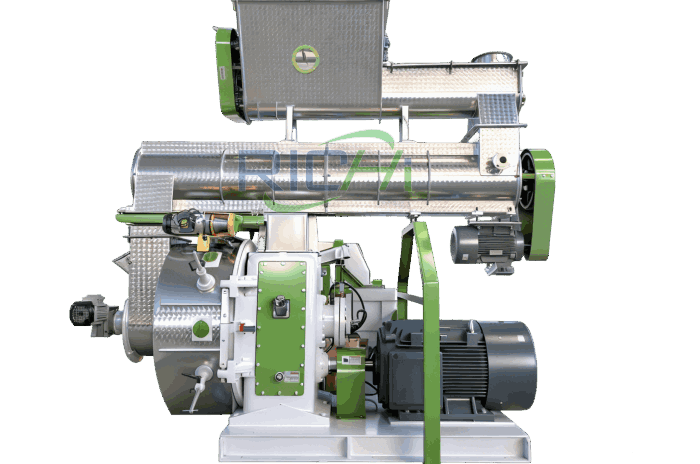
Granulation is the core step. A ring die granulator presses the mixed material through a die to form cylindrical granules. The die size determines the granule diameter. The pressure and moisture determine the hardness and porosity. The operator must balance these variables for each formula.
Drying removes excess moisture. If the granules are not dried properly, they may mold in storage or clump together in the bag. If they are overdried, they become brittle and generate dust. The dryer must be matched to the granulator output and the local climate.
Cooling brings the granules to near ambient temperature before screening and packaging. Warm granules can sweat inside the bag, leading to moisture migration and quality problems.
Screening separates granules by size. Oversized granules may be crushed and recycled. Fines are usually recycled back into the mix. The screening system should be efficient enough to keep the final product within the target size range.
Dust collection is not optional. Litter production generates dust at multiple points. A proper dust collection system protects workers, reduces product loss, and improves the working environment.
Packaging is the final step. The bag must protect the product from moisture and contamination. The filling system should be accurate to avoid giving away product or shorting customers. The bag design should reflect the brand and the target market.
Automation and the Case for a Full Automatic Plant
Labor is one of the biggest challenges in cat litter production. The process involves heavy materials, dusty conditions, and repetitive tasks. Manual operation increases labor cost, inconsistent quality, and safety risk. This is why many new projects consider a Full Automatic Cat Litter Manufacturing Plant.
Automation can cover batching, mixing, granulation, drying, cooling, screening, and packaging. PLC control systems manage the sequence and monitor key parameters. Sensors track temperature, moisture, speed, and load. Data logging supports traceability and continuous improvement.
But automation is not a simple upgrade. It requires skilled maintenance, reliable power, and a clear understanding of the process. A fully automatic plant that no one can maintain will perform worse than a simple manual line that is well managed. The level of automation should match the local labor market, the management capability, and the target product quality.
For larger plants, automation usually pays for itself through labor savings, consistent quality, and higher throughput. For smaller plants, selective automation may be more practical. Automatic batching and mixing reduce formula errors. Automatic packaging reduces labor and improves accuracy. The granulator and dryer may remain manually controlled if the operator is skilled.
Equipment Selection and Supplier Evaluation
Cat litter equipment is not the same as feed equipment, even though some machines look similar. The dies, rollers, and conditioning systems are designed for different materials and different objectives. A supplier that only sells feed equipment may not understand the specific requirements of litter production.
When evaluating a supplier, ask about their experience with cat litter materials. Ask what die configurations they recommend for bentonite, zeolite, or plant fibers. Ask how they control dust and moisture. Ask about spare parts availability and maintenance requirements. A serious supplier will ask about your raw materials, target granule size, and product performance requirements before recommending equipment.
Manufacturers with broader experience in granulation and processing equipment, such as Richi Machinery, may be able to offer insights that go beyond a single machine. But the buyer should still verify the supplier’s relevant experience. A company that has built feed lines may or may not understand the specific demands of cat litter.
For buyers who want to understand a manufacturer’s background and production history, look at here now to review the company profile and capabilities. This is a useful first step, but it should be followed by technical discussions, sample testing, and, if possible, a visit to a running plant.
Formula Development and Testing
Cat litter formula development is not a one-time task. Raw materials vary. Customer expectations change. Competitors introduce new products. A formula that works today may need adjustment next season.
Testing should cover the key performance indicators:
- Absorption speed and capacity
- Clumping strength and scoopability
- Odor control duration
- Dust level
- Granule hardness and durability
- Bulk density
- Moisture content
- Appearance and color
Simple tests can be done in-house. A measured amount of water can be added to a sample to check absorption and clumping. A shaker or tumbler can test durability. A dust chamber or simple sieving can estimate fines. These tests do not replace laboratory analysis, but they help the producer understand how changes in raw materials or process settings affect the product.
Common Problems in Cat Litter Production
Many cat litter projects run into predictable problems. Understanding them in advance can save time and money.
Granule strength. If granules are too soft, they break during packaging and transport, creating dust and reducing customer satisfaction. The cause may be insufficient binder, wrong moisture, wrong die pressure, or improper drying.
Dust. Dust comes from fines, brittle granules, and poor handling. It can be reduced by better screening, gentler conveying, and proper moisture control.
Clumping performance. If the litter does not clump well, the problem may be the bentonite quality, the granule porosity, or the ratio of fine particles in the mix.
Odor control. If odor control is weak, the zeolite or other active ingredient may be insufficient or poorly distributed. The granule structure may also affect how quickly odor molecules are absorbed.
Storage stability. If the product cakes or molds in storage, the drying and cooling steps may be inadequate. The packaging material may also allow moisture to enter.
Equipment wear. Abrasive materials like bentonite and zeolite wear out dies and rollers quickly. The plant must plan for regular replacement and choose wear-resistant materials where possible.
Project Planning and Investment
A cat litter plant is a capital project. It requires land, buildings, utilities, equipment, and working capital. The investment should be planned in phases.
Start with market research. Who are the target customers? What products do they buy? What prices do they pay? What performance do they expect? This information shapes the formula and the equipment.
Then define the production capacity. How many tons per day are needed? What is the expected growth over three to five years? The plant should be sized to meet current demand with some room for expansion, but not so large that the equipment sits idle.
Next, plan the layout. Material flow should be smooth. Storage should be adequate. Dust control and safety systems should be included. Utilities should be sized for current and future needs.
Finally, select equipment and suppliers. The cheapest option is rarely the best. Consider total cost of ownership, including energy, maintenance, spare parts, and downtime. Consider the supplier’s experience, support, and willingness to work with your specific materials.
Market Trends and Product Differentiation
The cat litter market is changing. Consumers are more aware of dust, odor, and environmental impact. They are willing to pay more for products that perform better and are easier to use. This creates opportunities for differentiation.
Eco-friendly litter made from plant fibers or recycled materials appeals to environmentally conscious buyers. Crystal litter made from silica gel offers strong absorption and low dust. Lightweight litter made from blends reduces the weight of the bag, which matters for older customers and online delivery.
Producers can differentiate through granule shape, size, color, scent, and packaging. But differentiation must be supported by the production process. A plant that cannot control granule size or dust level cannot deliver a premium product consistently.
Conclusion
Cat litter production is a manufacturing business with its own raw materials, process requirements, and quality standards. It is not simply feed pelleting applied to a different material. The plants that succeed are those that understand the relationship between raw materials, process settings, and product performance.
A cat litter production line can be simple or highly automated, depending on the scale and target market. A Full Automatic Cat Litter Manufacturing Plant offers labor savings and consistency, but it requires careful planning and capable management. The equipment is important, but it is only one part of a successful operation. Formula development, quality control, dust management, and market understanding matter just as much.
For producers who take the time to plan properly and test thoroughly, cat litter production can be a profitable and sustainable business. For those who rush in without understanding the material and the process, it can be an expensive lesson.