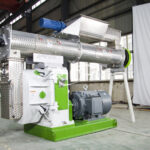


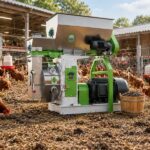

RICHI chicken feed pellet machine prices range from approximately USD 7,000 to USD 100,000 across the published SZLH model range, with individual machine capacities from 1–1.5 t/h to 38–40 t/h. The correct model depends on the feed formula, pellet diameter, grinding fineness, steam-conditioning arrangement, operating hours and whether the buyer needs a standalone pellet mill or a complete feed production line. A machine price should never be compared without checking the conditioner, die, roller, motor, transmission and included accessories.
1. Chicken Feed Pellet Machine Models, Capacity and Price
The following table reproduces RICHI’s published model-level price and capacity ranges. They are reference prices for early budgeting, not a final quotation for every electrical standard, conditioner, die or project scope.
| Model | Capacity | Reference Price (USD) | Typical Application |
|---|---|---|---|
| SZLH250 | 1–1.5 t/h | $7,000–12,500 | Small and medium poultry farms |
| SZLH320 | 3–4 t/h | $13,000–21,000 | Small commercial feed workshops |
| SZLH350 | 5–6 t/h | $22,000–32,000 | Medium commercial feed mills |
| SZLH420 | 10–12 t/h | $33,000–48,000 | Regional feed production facilities |
| SZLH508 | 15–16 t/h | $49,000–64,000 | Industrial feed plants |
| SZLH558 | 20–22 t/h | $65,000–70,000 | Large continuous-production plants |
| SZLH678 | 30–33 t/h | $71,000–78,000 | High-capacity feed mills |
| SZLH768 | 38–40 t/h | $91,000–100,000 | Large industrial feed projects |
Capacity is not independent of feed formulation. Broiler starter, grower, finisher and layer feeds can differ in ingredient composition, fat content, fiber, grinding fineness and pellet diameter. A capacity figure should therefore be tied to the formula and product specification used for the test. Also clarify whether the stated rate refers to mash entering the pellet mill or finished pellets after cooling and screening.
2. What Actually Changes the Price of a Chicken Feed Pellet Machine?
Capacity, ring die and main drive
As capacity increases, the ring die, shaft, bearings, frame and drive system generally need to be larger and stronger. Motor power and transmission configuration also affect price. Our machine configurations may include gearbox or belt drive options, variable-frequency control and possible dual-motor configurations as factors that influence the quotation. Buyers should compare the actual duty rating and parts list rather than judging a machine by motor brand alone.
Ring die and pressure rollers
The ring die and rollers are wear components that directly influence pellet formation. Material, heat treatment, hole diameter and compression ratio affect wear and product quality. Different poultry feed formulations and pellet diameters may require different die specifications. A low initial machine price can become expensive if the die is unsuitable for the formula and produces excessive fines or requires frequent replacement.
Conditioner and steam system
Steam conditioning adds heat and moisture to mash before pelleting. Single-, double- and triple-layer conditioners provide different material residence times and conditioning opportunities. A more elaborate conditioner may improve process control for selected formulas, but it also changes equipment cost and steam demand. The boiler, water treatment, piping, traps, insulation and controls may be separate supply items; confirm the boundary before comparing quotations.
Customization and service scope
Customized feeding, conditioner, die, controls and layout can increase the initial quotation, but may be justified when the plant has unusual formulas, limited floor space or a specific operating schedule. Compare warranty, installation, commissioning, training, spare parts and technical support alongside the equipment price. A cheaper machine that cannot maintain the required output or pellet quality may cost more over its operating life.
3. Feed Formula and Grinding: The First Conditions for Good Pellets
A pellet mill cannot correct an inconsistent mash. Corn, soybean meal, bran, minerals, oils and other ingredients must be dosed and mixed according to the feed formula. Grinding fineness influences surface area, conditioning and pellet formation. If particle size is too coarse or inconsistent, the mash may not compact uniformly; if it is unnecessarily fine, grinding energy rises and the process may not gain a corresponding improvement in pellet quality.
Before selecting the machine, provide representative formulas for the products the mill will manufacture. Broiler starter, grower, finisher and layer feeds should not automatically be treated as one identical process. State the target pellet diameter, durability requirement, fines limit and expected production schedule. The machine and die should be selected for the product range, not just one convenient sample formula.
4. Conditioning, Steam and Pellet Quality
Steam conditioning prepares mash before it enters the ring die. Heat and moisture influence starch behavior, mash plasticity and the ability of particles to bind under compression. Too little conditioning may produce weak pellets and excessive fines; too much moisture or an unsuitable temperature can create handling and durability problems. The right settings depend on formula, residence time, steam quality and pellet specification.
When reviewing a quotation, ask whether the conditioner is single-, double- or triple-layer, what steam supply is assumed, and whether the boiler and associated piping are included. Commissioning should use the customer’s actual formula and agreed product tests rather than relying on an empty-machine run or a short peak-capacity reading.
5. Standalone Pellet Mill or Complete Chicken Feed Production Line?
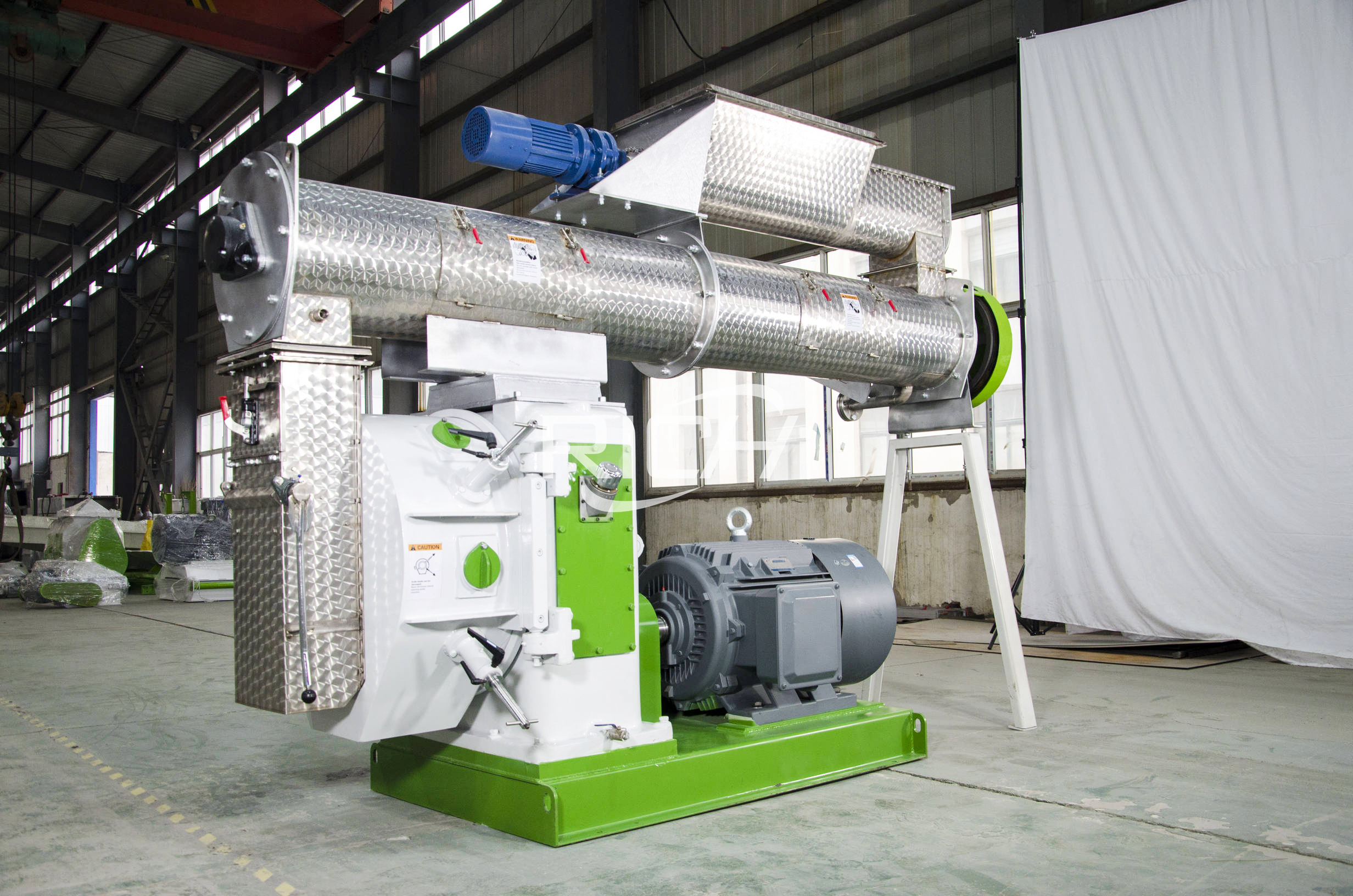
A ring-die pellet mill converts prepared mash into pellets; it does not replace the equipment needed to prepare ingredients or handle finished feed. A complete chicken feed line commonly includes receiving and cleaning, grinding, dosing, mixing, conditioning, pelleting, cooling, screening and packing. Depending on the plant, storage bins, conveyors, elevators, boiler, air compressor, dust collection and electrical controls may also be required.
| Process Stage | Typical Equipment | Why It Matters |
|---|---|---|
| Grinding | Hammer mill | Controls ingredient particle size |
| Batching and mixing | Dosing system, feed mixer | Maintains formula accuracy and mash uniformity |
| Conditioning | Conditioner, boiler and steam piping | Prepares mash for compression |
| Pelleting | SZLH ring-die pellet mill | Forms mash into pellets |
| Cooling | Counterflow cooler | Reduces pellet temperature and stabilizes product |
| Screening / crumbling | Vibrating screen, optional crumbler | Controls fines and produces smaller feed forms where needed |
| Packing | Weighing and bagging machine | Prepares finished feed for dispatch |
RICHI’s established scope covers feed single machines from 1–40 t/h and complete production lines from 1 t/h upward, with line capacity extending to 100 t/h depending on process design. These ranges describe available solution scope, not a promise that every formula can be processed at the maximum rate. The buyer should identify which existing equipment can be reused and which sections need replacement.
6. Production-Line Bottlenecks: The Pellet Mill Is Not Always the Limiting Machine
A 10 t/h pellet mill cannot sustain 10 t/h if the grinding section prepares only 8 t/h of mash or the cooler handles only 9 t/h of hot pellets. Compare the usable capacity of grinding, batching, mixing, conditioning, pelleting, cooling, screening and packing on the same formula and operating basis. Allow for batch cycle time, product changes, cleaning and routine maintenance.
For example, a line with a 10 t/h pellet mill, 8 t/h hammer mill, 10 t/h mixer, 10 t/h conditioner, 9 t/h cooler and 10 t/h packing system will be limited by the grinding and cooling sections. The practical line output cannot exceed the most restrictive stage. The solution may be a larger hammer mill, a second grinding stream or a cooler upgrade—not a larger pellet mill.
7. Operating Cost and a Transparent Payback Example
Operating cost includes electricity for grinding and conveying, steam or fuel, labor, die and roller replacement, packaging, cleaning and downtime. Some planning models use electricity at roughly 25%–35% of daily operating expenses, but the actual share changes with local tariffs, grinding fineness, loading, steam source and labor cost. Use the plant’s own utility and production records for a reliable cost per tonne.
Consider a small commercial project with USD 20,000 in equipment and installation investment. If it achieves net monthly savings of USD 2,000 after electricity, labor, wear parts and other incremental expenses, simple payback is 10 months. If net savings are USD 1,000 per month, payback becomes 20 months. The calculation is investment divided by net monthly savings; it should not be based on gross feed-price differences.
On-farm feed production can reduce purchased-feed margins, transport and handling costs in suitable circumstances. A 15%–25% potential feed-cost reduction is sometimes used as an early planning scenario, but it is not an automatic saving from pelletizing. The farm must compare its own ingredient, energy, labor, maintenance, packaging and financing costs against the delivered price of equivalent commercial feed.
8. Flat Die or Ring Die: Which Machine Is Appropriate?
Flat-die machines are generally considered for small or low-throughput applications, while ring-die pellet mills are the more common choice for commercial and industrial feed production. A flat-die unit may have a lower initial price, but it should not be selected for a plant that needs sustained multi-tonne-per-hour output. Ring-die systems integrate more readily with industrial conditioning, cooling and automated handling. The decision changes with required capacity, duty cycle, available budget and the existing process.
9. What Should Be Included in a Comparable Quotation?
- Required finished output, daily operating hours and annual production target.
- Representative feed formulas, ingredient properties and target pellet diameters.
- Capacity basis: mash input or finished screened pellets.
- Main motor, gearbox, ring die, roller and conditioner specifications.
- Grinding, batching, mixing, boiler, cooling, screening and packing scope.
- Electrical standard, plant layout, foundations and customer-supplied utilities.
- Freight term, installation, commissioning, training, warranty and spare parts.
For a project quotation, provide the formula range, capacity, pellet diameter, operating schedule, site location and existing equipment list. Review the RICHI chicken feed pellet machine price and model configuration against those inputs so the quotation reflects the actual production system rather than a machine-only comparison.
Conclusion
The right chicken feed pellet machine is the one that can process the customer’s formula and pellet specification at the required operating rate while fitting the complete feed mill. RICHI’s SZLH range covers 1–40 t/h individual machine capacities, but grinding, batching, conditioning, cooling and packing determine the finished line output. Compare the die and roller configuration, steam system, service scope and lifecycle cost—not just the machine’s initial price.
Frequently Asked Questions
How much does a chicken feed pellet machine cost?
RICHI’s published SZLH reference prices range from approximately USD 7,000 for the SZLH250 to USD 100,000 for the SZLH768. The final price depends on capacity, motor, drive, die, roller, conditioner and included accessories.
What capacity range is available?
The published individual feed pellet machine range covers approximately 1–40 t/h. Complete feed production lines are available from 1 t/h upward, with larger line capacity depending on process design and equipment configuration.
Does chicken feed pelleting require steam?
Steam conditioning is commonly used in industrial feed pelleting. Boiler capacity, steam quality, pressure stability, water treatment and piping should be matched to the conditioner and formula. The final arrangement depends on the product and process design.
Why does pellet diameter affect machine output?
Different pellet diameters require different die holes and may change compression resistance and operating conditions. Formula, grinding fineness and conditioning also influence throughput, so capacity should be confirmed using the target product specification.
What auxiliary equipment is needed for a complete chicken feed line?
A typical line includes a hammer mill, batching system, mixer, conditioner and steam supply, pellet mill, counterflow cooler, screen, optional crumbler, conveyors and packing equipment. The final list depends on the factory’s existing equipment and product range.